

November 24, 2026 Update
Text provided by the American Library Association: The 43-day federal government shutdown – the longest in history – has now ended. Congress passed a Continuing Resolution (CR) to reopen and fund government operations.
What does that mean for libraries?
- Funding for libraries, including programs administered by the Institute of Museum and Library Services (IMLS), will restart in the coming days as employees return to work.
- IMLS will resume administering state library grants that support interlibrary lending, shared digital resources, and other vital services through state library agencies.
Let's be clear that Congress did not agree on a new budget for FY 2026: they agreed to continue temporarily funding some programs at last year’s funding levels.
- Upside: Libraries aren’t losing IMLS funds. When the government reopens, IMLS funding will continue at Fiscal Year (FY) 2025 levels.
- Downside: The “fix” is temporary. The CR funds only three of 12 appropriations bills for FY 2026, which means Congress will need to pass nine spending bills or face yet another shutdown on February 1, 2026, for most government programs, including library programs.
Advocates have been communicating with Congressmembers all year to protect federal funding for libraries. ALA continues to manage our lawsuit against the Trump administration (still in process) for the March 15 executive order to dismantle IMLS.
If you would like to make your position on this issue known here are the links to look up your elected representatives and their contact information:
ARCHIVED INFORMATION
October 3, 2026 Update
From the Michigan Library Association: Michigan Libraries Secure Stable Funding in Michigan FY26 Budget
After months of uncertainty and statutory deadlines that came and went, Michigan’s FY26 budget moved through the Senate and House overnight. The budget now awaits the Governor’s signature as the final step in the process.
Considering the challenges leading up to this week, the outcome for libraries in the state budget is encouraging. The Library Services and Technology Act (LSTA) line item remains fully funded in the budget, ensuring the Library of Michigan can spend federal dollars as allocated on statewide programs like the Michigan eLibrary and catalog, MeL and MeLCat.
August 2025 Update
You may have heard that IMLS dollars are appropriated for FY2025-2026. While it is true the funds are appropriated, in order for those dollars to actually make their way to the Library of Michigan they must appear in the State of Michigan's budget. At the moment (8/12/25) IMLS funds appear in the Michigan Senate budget but not the Michigan House budget. IMLS must show in both budgets during the budgeting process, and the final budget that goes to the Governor for signature.
Update July 2025: New YTD MeLCat statistics in graphic
Here is a fact sheet for funded programs (FY 2023).
Here is a link to the Library of Michigan's five year plan.
Do TADL cardholders benefit from IMLS dollars?
Yes. TADL cardholders benefit in a variety of ways:
- The Michigan eLibrary and electronic catalog (MeLCat) - allows TADL cardholders to borrow books from any participating library statewide. TADL cardholders are avid MeLCat users, requesting on average 50-60 books a day through MeLCat! This saves libraries money by allowing the public to borrow a wider variety of books, including multiple copies for book clubs, out-of-print books, and items in academic libraries. Databases and interlibrary loan are funded 75% from IMLS and 25% from the state legislature. This means that if IMLS is dismantled, the Library of Michigan will no longer be able to provide the databases and MeLCat will have to shut down. (Long read: Detroit Bookfest feature on MeLCat and interlibrary loans)
- TADL has received direct grants to create STEM kits for the collection and received a direct grant during the summer of 2021 to create interactive summer projects for young/teen readers.
- Statewide preservation efforts - Just last week TADL (as a network member) celebrated a ribbon-cutting for Michigan’s Digital Preservation Network, a series of servers housing digital copies of Michigan’s cultural resources. This network was funded by a large IMLS grant.
- Training benefits - On the TADL staff side, TADL benefits from IMLS too. The funding makes it possible for staff
members to access on-demand training, webinars, and other classes. The on-demand training helps us train new employees and keep staff current on new topics without incurring cost for travel or planning for staff members to be out of the library for training. IMLS monies pay for professional education stipends that TADL staff has used to attend Michigan and national conferences. IMLS monies pay for our Friends and Trustees to belong to United for Libraries and for the entirety of the state of Michigan public libraries to participate in the Collaborative Summer Library Program (which is where we get our summer reading curriculum).
According to the State Librarian Randy Riley, MeL databases and MeLCat are funded through September 30, 2025. During President Trump's past presidency, he always defunded the IMLS but Congress would put the department back into the national budget. If funds are not restored this would mean that after September 30, 2025 TADL cardholders will only have access to the materials in our six TADL libraries, not participating MeLCat libraries throughout the state.
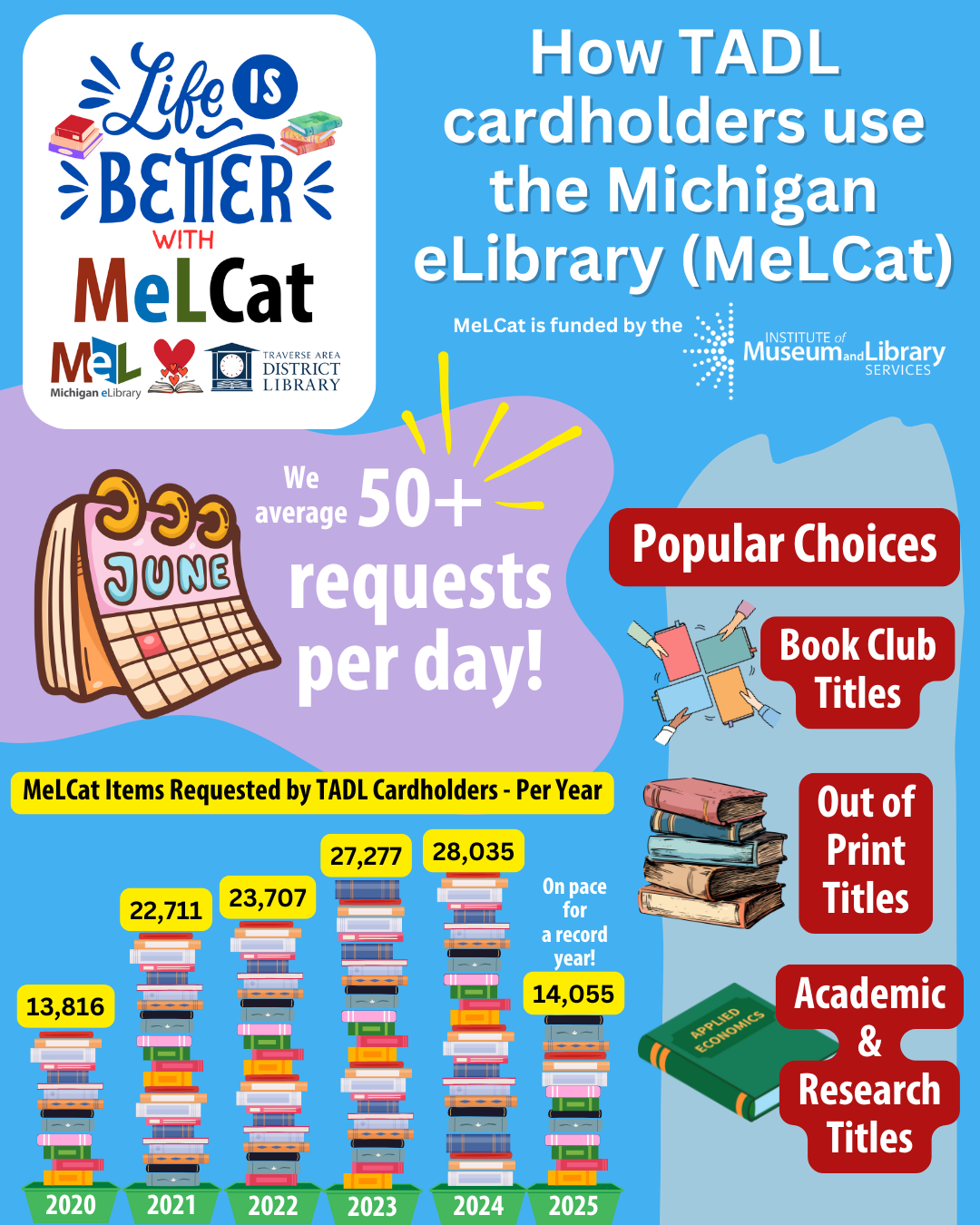
Infographic Data
How TADL Cardholders use MeLCat
We average 50+ requests per day!
MeLCat Items Requested by TADL Cardholders - Per Year
2020 - 13,816
2021 - 22,711
2022 - 23,707
2023 - 27,277
2024 - 28,035
2025 (thru June) - 14,055 (on pace for a record year!)
Popular Choices
Book club titles
Out-of-print titles
Academic & research titles
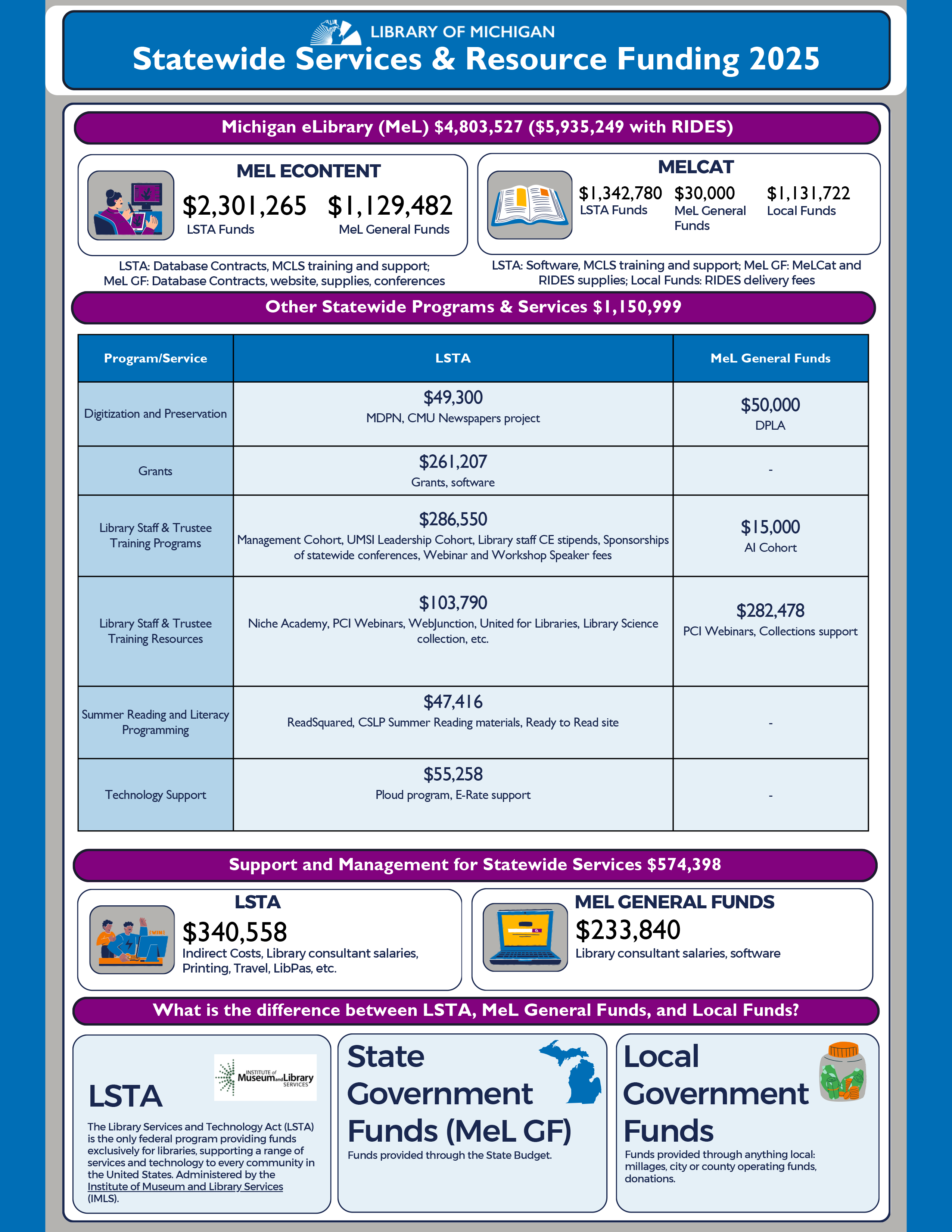

Statewide MeLCat Statistics
Infographic Facts & Figures
Value of $26.96 returned for every $1 spent
1 Million MeLCat items loaned in 2024
10 Million MeLCat items loaned since 2015
9.2 Million Trusted Articles & Journals Accessed
10.7 Million WiFi Connections at the Library
$384,715 granted to libraries directly
101,127 WiFi hotspots borrowed

Library of Michigan LSTA Snapshot Infographic
Data: Library of Michigan annual report